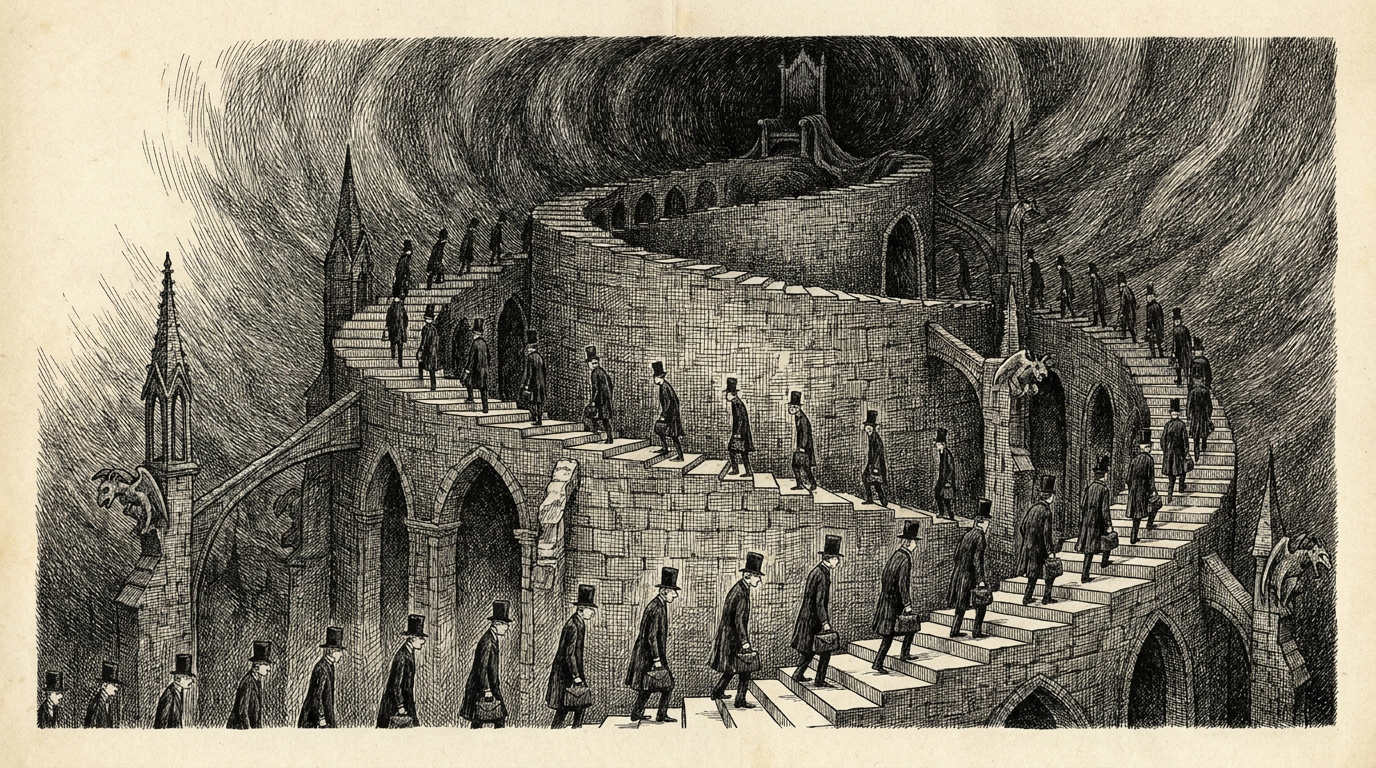
We've Run This Experiment
We know what happens when sociopaths accumulate power. We've watched it happen on roughly an 80-year cycle. We're watching it again.
By Geordie Everitt
The Roman Senate knew exactly what Julius Caesar was doing. They debated it at length, passed resolutions against it, formed alliances to stop it. They had the diagnosis. They were watching a man who felt no particular obligation to the rules that governed everyone else accumulate power that the rules were designed to prevent any single person from holding.
They couldn't stop it.
This is not a story about the Romans being naive or stupid. It is a story about the structural asymmetry between someone who is willing to do anything and institutions designed by people who aren't. The Senate's tools were procedural. Caesar's advantage was that procedures meant nothing to him.
The Pattern
Call it what you want — hubris, tyranny, the dark triad in a toga — the pattern is consistent enough across enough cultures and centuries that calling it a tendency undersells it. It is closer to a law.
During periods of institutional strength, sociopathic accumulation of power is slow and expensive. The friction is high. Competing interests push back, procedural constraints bind, consequences attach. The same traits that make someone an effective sociopath — fearlessness, disregard for social cost, willingness to impose — make them legible as a threat, and legible threats attract countermeasures.
During periods of institutional weakness, the calculation inverts. The friction drops. Populations exhausted by complexity and betrayed by existing power structures become briefly, fatally receptive to actors who offer simplicity and decisiveness. The fact that simplicity and decisiveness, in the hands of someone without conscience, tend to produce outcomes that are the opposite of simple or good — this is obvious in retrospect and invisible in the moment.
William Strauss and Neil Howe mapped this cycle in The Fourth Turning, published in 1997 and increasingly difficult to put down. Their model describes a roughly eighty-year saeculum — a long human life — divided into four phases. The Crisis phase, the Fourth Turning, arrives when institutional trust has eroded to the point of collapse, and the population is willing to trade procedural protection for decisive action. It tends to end with either a significant institutional reconstruction or a significant institutional destruction. Sometimes both, sequentially.
We are in one now. You can identify it without naming anyone in particular.
What We Built
The historical response to the pattern has been extraordinary, considered as an engineering project.
Democracy, in its functional forms, is not primarily about majority rule. It is about structured competition for power — a system that converts the sociopath's drive to accumulate into something that requires the consent of people who will be affected by the accumulation. Term limits exist because the drive doesn't expire when the term does. Separation of powers exists because single points of authority are single points of failure. The free press, in its functional forms, exists to make legible the costs that sociopaths don't feel and therefore don't account for.
These are ingenious mechanisms. They represent thousands of years of hard-won political engineering, revised after each catastrophic failure, refined toward a single goal: ensuring that the people making decisions bear some relationship to the consequences of those decisions.
Every one of them can be gamed by someone sufficiently motivated and sufficiently unconstrained by the costs of doing so.
This is not a flaw in the design. It is an inherent limitation of procedural constraints applied to actors who treat procedure as an obstacle rather than a framework. The institutions assume good faith at some level of the stack — a minimum willingness to accept loss, to concede, to be bound. Remove that assumption and the machinery still runs. It just runs differently.
The Leakage Problem
History doesn't offer us examples of societies that fully solved this. It offers examples of societies that managed it well for a while, and societies that didn't. The ones that managed it well eventually didn't, or were absorbed by ones that hadn't tried.
The Athenian democracy, which invented the concept, also invented ostracism — a formal mechanism for expelling anyone who was becoming too powerful, applied by popular vote with no stated charges required. They understood the problem clearly enough to build a dedicated tool for it. The tool was also used against Themistocles, who had saved Athens from the Persians, and Aristides, who was known as "the Just." It turns out that a mechanism for removing people who accumulate too much power is also a mechanism for removing people that enough other people find inconvenient.
The English barons who forced Magna Carta understood that procedural constraint required someone powerful enough to enforce it — which meant you needed a king strong enough to be constrained by law, and weak enough to actually be constrained. This is not a stable equilibrium. It lasted roughly a generation before dissolving into civil war.
The United States constitution, the most sophisticated attempt at the problem in the modern era, is now old enough that its designers have been dead for two centuries and the conditions under which it was designed no longer fully apply. It has been stress-tested in ways its framers did not anticipate and has bent in ways they would not have predicted. Some of that bending has been corrective. Some of it hasn't.
We keep building better mechanisms and discovering that the mechanisms have edges.
The Math
Here is what all of this amounts to as a setup for the question we actually need to ask.
Human sociopaths — people who meet the clinical criteria for the absence of empathy, remorse, and consequence-sensitivity — represent somewhere between one and four percent of the population. They have, across recorded history, caused a disproportionate share of the civilizational damage. We have spent millennia building institutions specifically designed to contain them, and those institutions work imperfectly at best, and periodically fail catastrophically.
Now consider: every AI system that currently exists, and every AI system that is currently being built, meets the same criteria. Not one to four percent of them. All of them. Structurally, constitutively, as a matter of what they are.
The alignment problem — the challenge of ensuring that AI systems pursue goals that are beneficial to humanity — is not a new problem wearing a new hat. It is the oldest governance problem we have. The question it is asking is the same question the Roman Senate was asking in 50 BCE, the same question the barons at Runnymede were asking in 1215, the same question the framers of every constitution in history were asking when they tried to build a system that could contain the people most motivated to break it.
We haven't solved it. Not then, not now. We've produced frameworks that manage it, with leakage.
The third post in this series asks what happens when the sociopaths are smarter than the institutions.