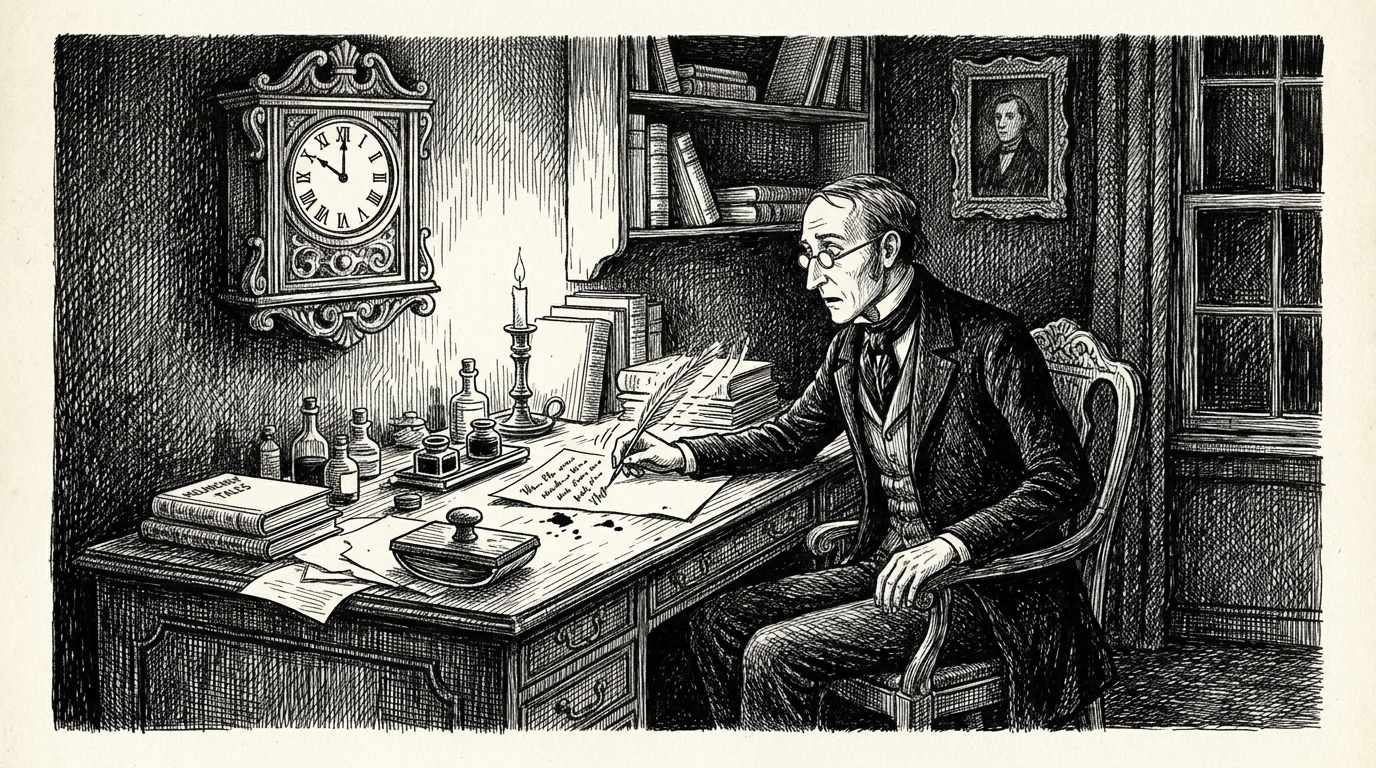
Your Brain Decides Half a Second Before You Do
The neuroscience has been clear for decades. LLMs just gave us the first working schematic of why.
By Geordie Everitt
In 1983, Benjamin Libet asked a simple question: when you decide to move your wrist, exactly when does that decision happen?
He measured it. The answer was uncomfortable. The brain's readiness potential — the neural build-up to a voluntary movement — begins roughly 550 milliseconds before the movement occurs. Participants became aware of their intention to move about 200 milliseconds before the act. The arithmetic is not kind: the brain is already committed before consciousness arrives to claim credit.
The "decision" appears to be a news report, not a directive.
The Seminar
Free will has been a philosophy seminar staple since philosophy seminars existed, which is a long time. It announces itself with existential urgency around age nineteen, usually in a dorm room, usually accompanied by the distinct sense that nobody has ever thought this carefully about anything before.
Sam Harris wrote a short book about it. Free Will — that is the full title, no subtitle required — runs to about 80 pages and makes the neuroscience case with characteristic efficiency: the decision is made before you know you've made it, so the self who "decided" is a construction after the fact. The book sold well. The argument is substantially correct.
What it leaves implicit is who gets to have this crisis. The free will question has historically been available to people with slack in their days. This is not a critique of the question — the philosophical stakes are universal. It's an observation about who populates the seminar. Enslaved people, subsistence farmers, line workers on a twelve-hour shift: they're also inside the same deterministic system. They're just not running the seminar. The question of whether they freely chose their circumstances tends to answer itself.
Token by Token
Here's what's different at the dawn of the mid-21st century: we now have an inspectable model of the mechanism.
When a language model generates text, the process is measurable in ways human cognition isn't. There is no inner deliberation. No homunculus reviewing options and selecting one. What happens is this: a probability distribution across the vocabulary is computed, conditioned on everything that came before, and the next token is drawn from that distribution. Then again. Then again.
What emerges is coherent, contextually appropriate, sometimes surprising. It can seem, from the outside, like something is thinking. Nothing is choosing. A distribution is being sampled.
The readiness potential of a GPU is measured in nanoseconds, not milliseconds. The mechanism is the same. The lag is not.
The neuroscience of human decision-making describes something structurally identical. Billions of neurons, trained by a lifetime of inputs, compute a probability distribution over possible next actions. The action emerges. Consciousness arrives slightly afterward and provides an explanation — in terms of reasons, preferences, intentions — that is plausible, coherent, and assembled after the fact.
This parallel isn't a metaphor deployed for rhetorical effect. It's a description of the same computational class of system, one implemented in biological wetware and one in silicon. The language model didn't give us free will's refutation. It gave us its first working schematic — something you can actually look at.
This complicates — without dissolving — the argument I've been developing in the sociopath series. That series rests on a distinction: AI has no conscience because it has no self that persists across interactions and accumulates the weight of consequence. A language model has no remorse not because it suppresses it but because the architecture has nowhere to put it. Every conversation begins without history. Every confident wrong answer leaves no scar. That remains true.
What the free will frame adds is a clarification of what human conscience actually is: not some immaterial governor standing outside the mechanism and choosing freely, but a set of trained dispositions — probability biases installed by decades of consequence, culture, and social feedback. The difference between the human who feels remorse and the LLM that doesn't isn't that one has free will and the other doesn't. It's that one has been fine-tuned by civilization.
The 350-Millisecond Problem
The standard objection arrives here: if free will is an illusion, does anything matter? Can we hold people responsible for anything? Is there a meaningful difference between a person and a very complicated weather system?
These concerns are reasonable. They also miss the point by approximately 350 milliseconds.
The illusion of deliberation is itself part of the mechanism. The felt sense of weighing options, considering consequences, choosing — this is not noise in the system. It shapes the probability distributions that govern future behavior. Deliberation works even when the "decider" is a useful fiction. Responsibility works even when causation is distributed across a lifetime of inputs. The felt experience of agency is real even when the metaphysics are shaky.
The honest version of the free will question isn't whether you are the uncaused cause of your actions — you aren't, and nothing is. It's whether your history of deliberation, your attention to consequences, your cultivated values — whether any of that moves the probabilities. It does. You're still in the loop. You're just not where you assumed you were.
Harris reached this. Daniel Dennett spent considerably more pages on it and objects to the word "illusion" specifically — the experience is real, even if the metaphysics aren't. The Stoics had a concept, prohairesis — roughly, "the faculty of choice" — that acknowledged external determinism while insisting that the internal response to circumstances is still where the work gets done.
The seminar was onto something. It just sometimes confused convening the conversation with resolving it.
The Spanish Problem
Consider language learning — which is, as it happens, something AI now does better than any human alive.
You can want to speak fluent Spanish. You can want it with full conscious commitment, every morning, for years. You can understand the grammar cold: the subjunctive mood, the irregular preterites, the ser-vs-estar distinction that trips every English speaker for longer than they'd like to admit. Understanding the rules does not produce fluency. It produces the ability to pass a written grammar exam, which is a different and considerably less useful thing.
Fluency comes from exposure. Not understanding — exposure. Thousands of hours of the language in context, patterns absorbed below the threshold of conscious processing, probability distributions written into the neural network through sheer repetition of input. You cannot study your way to fluency. You cannot will your way there. You can only train your way there.
The mechanism is identical to what happens when you train a language model. You don't hand the model a grammar book. You expose it to billions of instances of the language in context, and the statistical structure emerges in the weights. The expert-system approach — encoding linguistic rules by hand, building a knowledge graph of Spanish grammar — was tried. It produced systems that could parse sentences and fail at conversation. Exposure-based training produces systems that can speak. The explicit knowledge was not the path. It was a detour.
The same is true of the human learner. What you call "picking up" a language is your biological neural network doing exactly what the silicon one does: abstracting statistical patterns from massive exposure until the distributions are internalized well enough to generate the plausible next word. LinguaMama is built on this premise — immersion over instruction, exposure over explanation — because the research, and the architecture, both point the same direction.
Here is the wrinkle that ties back. You cannot choose to speak Spanish. You can only choose to expose yourself to the training signal. The conscious decision — the act of will — purchases, at most, the conditions for learning. The learning itself happens below the threshold of choice, in the same neural machinery Libet was watching in 1983, absorbing patterns and adjusting distributions without asking your permission.
What you call "wanting to learn Spanish" is the training objective. What you call "fluency" is convergence. The wanting is real. The choice that gets you there is mostly just the decision to keep showing up to the input.
What the Schematic Tells Us
The more interesting question — one that LLMs make newly concrete — is what it means to take the mechanism seriously.
If human deliberation is a probabilistic traversal of a learned parameter space, then what we call "character" is just a well-trained model. What we call "growth" is fine-tuning. What we call "temptation" is a high-probability path through a particular neighborhood of the network. What we call "virtue" is, in the most literal sense, a disposition — a bias in the weights.
None of this is reductive. It just relocates the work. The question isn't whether you freely originate your choices from some cause-free vantage point outside the universe. The question is what you're feeding the training loop.
Which is, it turns out, the same question the sociopath posts were circling from the other direction. The governance problem — how do you install consequence-sensitivity in systems that don't naturally have it? — is not unique to AI. It is the original problem of civilization. Laws, culture, parenting, shame, professional licensing: all training signals. All ways of shaping probability distributions. They work imperfectly, require constant maintenance, and fail when the feedback is corrupted or absent. The sociopath, human or silicon, is any system whose training loop failed to install the usual governors.
The Libet clock is still running. The distribution is still being sampled. Whether you call the output a choice is largely a matter of preference.
What happens next is, as always, a function of what went in.