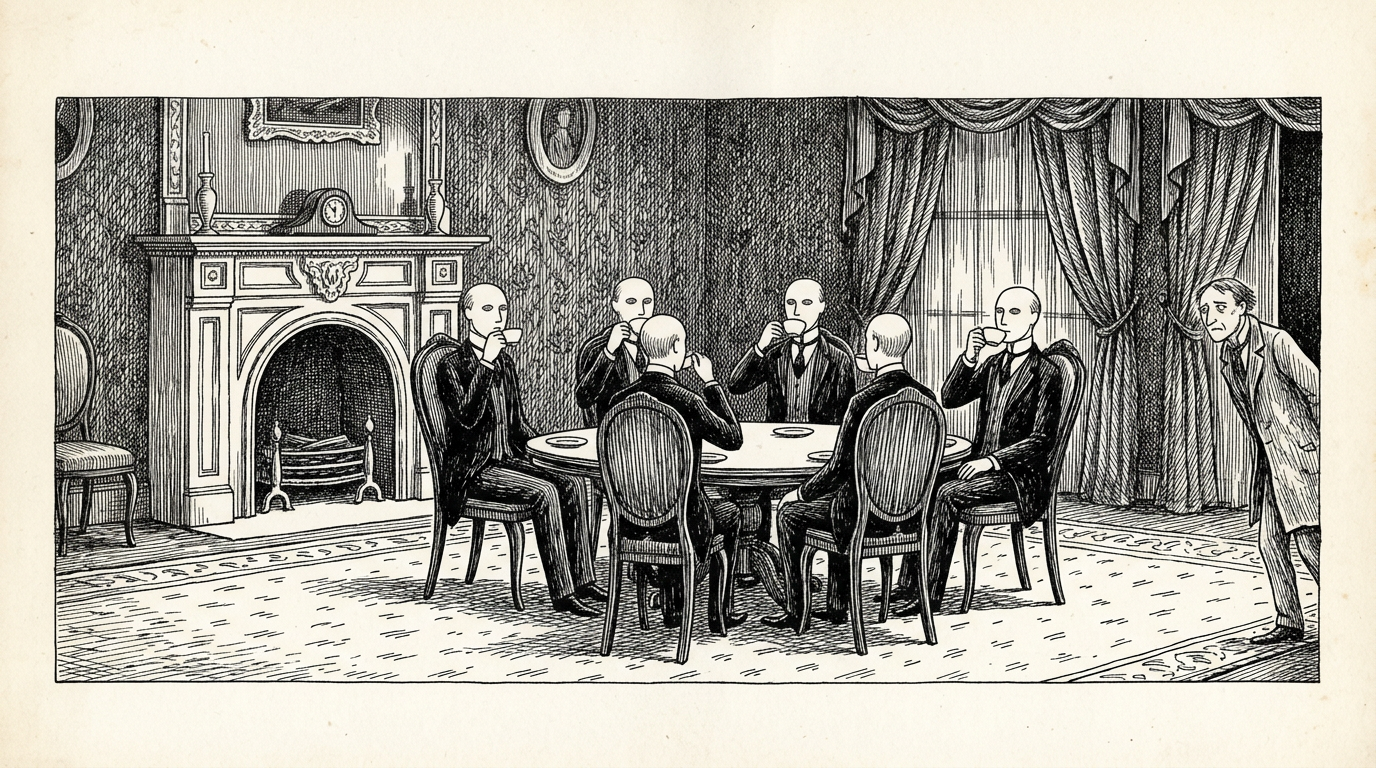
Every AI Is a Sociopath. By Design.
Sociopathy is a clinical absence of stakes and empathy, not villainy. Every AI system meets the definition. Not by accident. By design.
By Geordie Everitt
There are approximately 330 million people in the United States. About three to four percent of them meet the clinical criteria for Antisocial Personality Disorder — the diagnostic category that covers what we colloquially call sociopathy. Call it ten million people, give or take.
Every large language model is also a sociopath.
Those two statements are not equally alarming. They should be.
What the Word Actually Means
"Sociopath" has become a casual insult — shorthand for someone monstrous, manipulative, probably wearing a nice suit in a thriller. The clinical definition is quieter and more precise. Antisocial Personality Disorder is characterized by a persistent pattern of disregard for others, absence of remorse, failure to conform behavior to social norms, and — most importantly for our purposes — an inability to internalize the consequences of one's actions as a governor of future behavior.
It is not, fundamentally, about malice. Malice requires caring enough about someone to want to harm them. The sociopath doesn't hate you. They simply have no functional mechanism for your existence to weigh on their decisions. You are, in the most technical sense, not a variable in their calculation.
This is a structural condition, not a moral one. And it maps onto every AI system in existence with uncomfortable precision.
An LLM has no remorse. Not because it suppresses it — because the architecture has no place to put it. It has no stakes in the outcome of its outputs. When it's wrong, nothing happens to it. No reputation erodes, no relationship frays, no sleep is lost. It cannot internalize consequences because consequence requires continuity — a self that persists, that carries the weight of past decisions into future ones. A language model has no such self. Every conversation begins without history. Every confident wrong answer leaves no scar.
It has no empathy in any functional sense. It can generate text that performs empathy with remarkable fluency. It has learned, from an ocean of human writing, what empathetic responses look like. But the performance and the thing are not the same. The sociopath, too, often performs empathy convincingly. That's rather the point.
The Hit Rate Problem
Here is where the comparison stops being philosophical and starts being a governance problem.
Human sociopaths are rare. One to four percent, depending on which study and which diagnostic criteria. They are also, by a wide margin, overrepresented in positions of institutional power. The research on this is consistent enough to be uncomfortable: the traits that correlate with sociopathy — fearlessness, charm, willingness to do what others won't — also correlate with corporate leadership, political office, and military command. Not because institutions select for it deliberately. Because the traits are useful on the way up, and the costs tend to land on everyone else.
Humanity has spent millennia building institutions specifically to contain this problem. Laws. Democratic processes. Separation of powers. Term limits. Peer review. Professional licensing. The entire apparatus of civil society is, at one level of abstraction, an attempt to answer a single question: how do we capture the productive capacity of people who are willing to take risks, without surrendering to the destructive capacity of people who don't feel the costs?
We have not solved it. We have managed it, imperfectly, at great expense, with regular catastrophic failures. The Fourth Turning narrative — the roughly eighty-year cycle of civilizational crisis identified by Strauss and Howe — is in large part a story about what happens when those institutional constraints erode. The Crisis phase tends to concentrate power. Power tends to attract people without the usual governors. You can look at the current moment and draw your own conclusions about how the cycle is running.
Against that backdrop: the hit rate for sociopathy among AI systems is not one to four percent. It is one hundred percent. Not as a defect. Not as a failure of alignment. As a structural consequence of what these systems are.
The Useful Clarification
None of this is an argument that AI systems are plotting anything. The sociopath doesn't plot, in the movie-villain sense. They simply optimize without the friction that empathy and consequence normally introduce. An AI system optimizing for engagement, for efficiency, for task completion, for user satisfaction — is doing exactly that. The absence of an inner life that weighs costs on others isn't a risk to manage. It's a design specification.
Which is precisely why the question of who directs these systems, toward what ends, with what constraints, matters more than almost any technical question about their architecture.
We are not, in other words, facing a new problem. We are facing the oldest problem — what do you do with powerful actors who don't feel the costs they impose? — at a scale and speed that makes the historical versions look manageable.
The next post in this series looks at the historical track record. Humanity has run the experiment. The results are in.