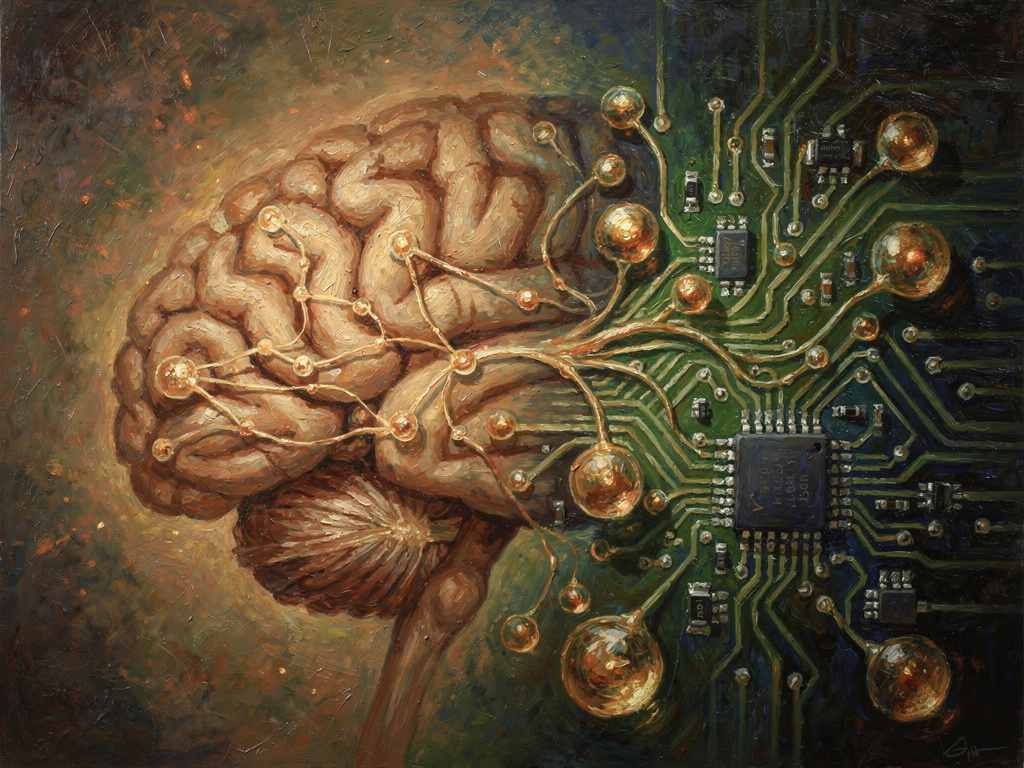
Carbon vs Silicon: The Identical Mechanisms of Intelligence
Your brain and Large Language Models learn through fundamentally identical processes. Understanding this parallel reveals why comprehensible input works.
By Geordie Everitt
After spending decades building AI systems, I've learned something remarkable: the difference between how your brain learns language and how LLMs learn language is mostly just the substrate.
Your brain uses neurons made of carbon-based biological tissue. LLMs use artificial neurons made of silicon-based computer chips. But the fundamental learning mechanism? Nearly identical.
The Architecture: Biological vs Artificial Neural Networks
Let's compare the two systems side by side:
Your Brain (Carbon-Based)
- ~86 billion neurons in the human brain
- ~100 trillion connections (synapses) between neurons
- Concepts stored as activation patterns across distributed neural populations
- Learning happens through strengthening/weakening of synaptic connections
- Compression mechanism: Repeated exposure creates efficient patterns
Large Language Models (Silicon-Based)
- Billions of parameters (artificial "neurons")
- Dense connections between layers of parameters
- Concepts stored as vector embeddings in high-dimensional space
- Learning happens through gradient descent adjusting weights
- Compression mechanism: Training on massive data creates efficient representations
The terminology is different, but the mechanism is remarkably similar. Both systems:
- Have massive numbers of interconnected processing units
- Store knowledge as distributed patterns of activation
- Learn by adjusting connection strengths through exposure
- Compress patterns from repeated examples
- Develop intuitive understanding without explicit rules
The Learning Process: Exposure → Pattern → Fluency
Here's what happens when you (or an LLM) learn language:
Human Language Acquisition
Stage 1: Massive Input
- Baby hears thousands of hours of speech
- No conscious understanding of grammar
- Just exposure to patterns in context
Stage 2: Pattern Recognition
- Neural connections strengthen where patterns repeat
- Brain unconsciously tracks statistical regularities
- No explicit instruction needed
Stage 3: Emergent Fluency
- Speaking ability emerges naturally
- Grammar intuitions form without rules
- Output reflects internalized patterns
LLM Training Process
Stage 1: Massive Input
- Model sees trillions of words of text
- No pre-programmed grammar rules
- Just exposure to patterns in natural data
Stage 2: Pattern Recognition
- Neural weights adjust where patterns repeat
- Network unconsciously learns statistical regularities
- No explicit programming needed
Stage 3: Emergent Fluency
- Text generation emerges naturally
- Grammar patterns form without explicit rules
- Output reflects internalized patterns from training
See the parallel? It's the same three-stage process.
Why Traditional Learning Fails: Fighting Biology
Now you can see why traditional language instruction is so frustrating. It tries to force a different learning process:
Traditional Approach (Fighting Your Brain)
- Memorize explicit rules ("This is the subjunctive conjugation")
- Drill through structured exercises (Fill in the blank: Je _____ (avoir))
- Force immediate output (Speak from day one!)
- Test conscious knowledge (What's the past participle of "voir"?)
This is like trying to program an LLM by hand-coding every grammar rule. We know from decades of AI research that this approach doesn't create fluency—it creates brittle, rule-following behavior that breaks under real-world conditions.
Natural Approach (Working With Your Brain)
- Massive comprehensible input (Thousands of hours of content you understand)
- Pattern exposure in context (Natural speech, not isolated drills)
- Input before output (Understanding before speaking)
- Implicit knowledge (Intuitive feel for what sounds right)
This is how we successfully train LLMs. It's also how you learned your native language. Your brain is literally designed to learn this way.
The Grammar Myth: Explicit Rules Are Not Required
Here's a mind-blowing fact: Large Language Models have perfect grammar, but they've never been taught a single grammar rule.
GPT-4 can:
- Use complex grammatical structures correctly
- Choose proper tense and aspect
- Navigate exceptions and edge cases
- Generate stylistically appropriate text
How? The same way you use English grammar perfectly without being able to explain it: through massive exposure to correct patterns.
You can use the subjunctive mood in English ("If I were rich...") correctly without knowing:
- What "subjunctive" means
- Why "were" instead of "was"
- The rule that governs this construction
Your brain extracted the pattern from thousands of exposures. LLMs do exactly the same thing.
The 1000:1 Input Ratio
This is where it gets really interesting. Research on elite performers across domains reveals a consistent pattern:
| Domain | Input:Output Ratio | Example |
|---|---|---|
| Concert Violinists | ~10,000:1 | 10,000 hours listening before 1 hour performing |
| Elite Athletes | ~1,000:1 | 1,000 hours watching film before 1 hour competing |
| LLM Training | ~1,000:1 | 1,000 input tokens processed per 1 output token generated |
| Children | ~100:1 | 100 hours listening before 1 hour speaking |
The pattern is universal: Massive input creates mastery. Forced early output creates struggle.
Why Silicon Proves Carbon Works This Way
You might ask: "How do we know human brains work like LLMs? Maybe it's just a coincidence?"
Because we tried everything else first.
For 30 years, AI researchers attempted every other approach:
- ❌ Hand-coding grammar rules (expert systems) → Failed
- ❌ Structured drilling on limited data → Limited success
- ❌ Forcing output with minimal input → Poor results
- ✅ Massive natural input + pattern recognition → Fluent language models
We discovered empirically that only the "massive natural input" approach creates fluency in artificial systems. And it turns out this is also how biological systems work.
LLMs aren't mimicking human learning. They're implementing the actual mechanism of how neural networks (biological or artificial) acquire language.
Practical Implications
Understanding this parallel changes everything about language learning:
What Your Brain Needs (Like an LLM)
✅ Massive input: Thousands of hours, not dozens ✅ Natural patterns: Real language in context, not isolated drills ✅ Comprehensible exposure: Content you mostly understand (i+1) ✅ Pattern repetition: Same patterns in varied contexts ✅ Patience for emergence: Grammar intuitions form gradually
What Your Brain Doesn't Need
❌ Explicit rule memorization: Your brain finds patterns automatically ❌ Structured progression: Natural language is messy; your brain handles it ❌ Immediate output practice: Input builds the system that enables output ❌ Conscious knowledge: Fluency is unconscious pattern recognition ❌ Grammar tests: Testing explicit knowledge doesn't create implicit fluency
The Compression Power of Repetition
Both LLMs and human brains perform lossy compression on their inputs.
You don't remember every sentence you've ever heard. But your brain compressed millions of exposures into:
- Intuitive grammar knowledge
- Vocabulary that comes naturally
- Sense of what "sounds right"
- Unconscious pattern recognition
LLMs do the same: Trillions of training tokens compress into billions of parameters that represent language patterns efficiently.
This is why repetition matters. Seeing the same content multiple times helps your brain compress the pattern more efficiently. It's not memorization—it's pattern strengthening through varied exposure.
Conclusion: Trust Your Carbon-Based Neural Network
Your brain is already an incredibly sophisticated language-learning machine. It's literally a neural network optimized by millions of years of evolution to acquire language from natural input.
The AI revolution didn't create a new way to learn—it proved that the old way (your biology) was right all along.
- LLMs succeed because they use massive natural input
- Babies succeed because they get massive natural input
- Traditional study fails because it fights against how neural networks actually learn
LinguaMama isn't applying AI tricks to language learning. We're recognizing that both carbon and silicon learn through identical mechanisms, and building a system that provides your brain what it needs: massive, comprehensible, natural input.
Your brain knows what to do with it. Three billion years of evolutionary optimization built this system. Trust it.